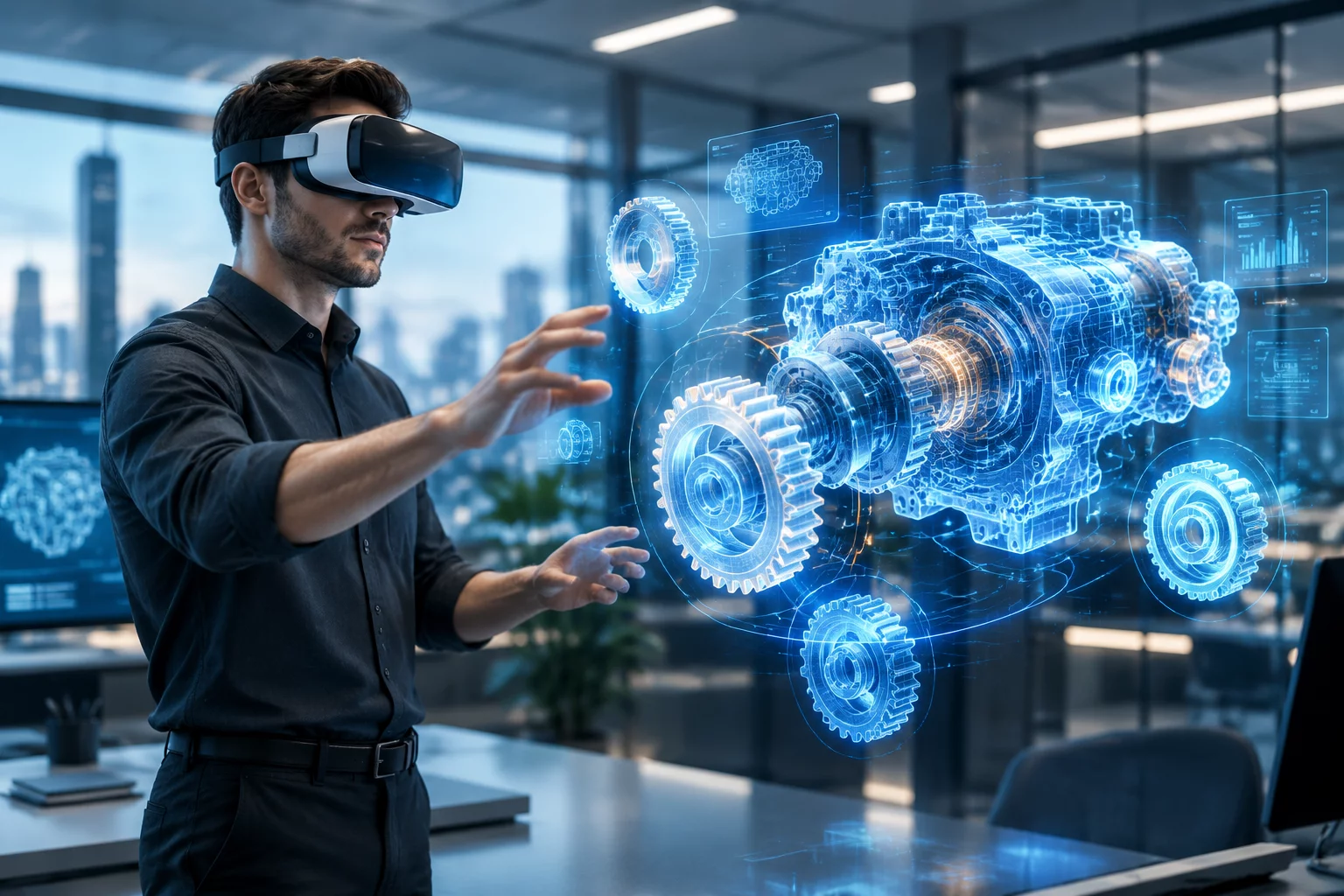
Immersive VR Engineering bridges physical intuition and digital geometric modeling. Engineers manipulate solid bodies directly in 3D space, assess mechanical clearances in life-size scale, and simulate kinematic motion paths using six degrees of freedom controllers without needing secondary rendering stages.
Spatial Immersion Meets Precision Boundary Representation
Traditional computer-aided design confines complex three-dimensional objects behind flat two-dimensional displays. Engineers often struggle to assess ergonomic clearances, true spatial volume, and reachability across intricate machine assemblies. Immersive VR Engineering removes this perceptual barrier by projecting parametric solid bodies into an unconstrained virtual environment.
Core Spatial Engineering Advantages
- Direct spatial inspection of complex assemblies with 6-DOF hand tracking.
- Dynamic cross-sectioning planes allowing instant internal tolerance verification.
- Zero latency WebAssembly geometric tessellation optimized for high-refresh VR headsets.
Interoperability & Hardware Compatibility
Built directly on the modern WebXR standard, the virtual environment connects to major standalone headsets and tethered spatial displays without custom client installations. Assembly modifications, dimension callouts, and section snapshots taken inside virtual space synchronize seamlessly with standard STEP and IGES outputs for downstream production.